
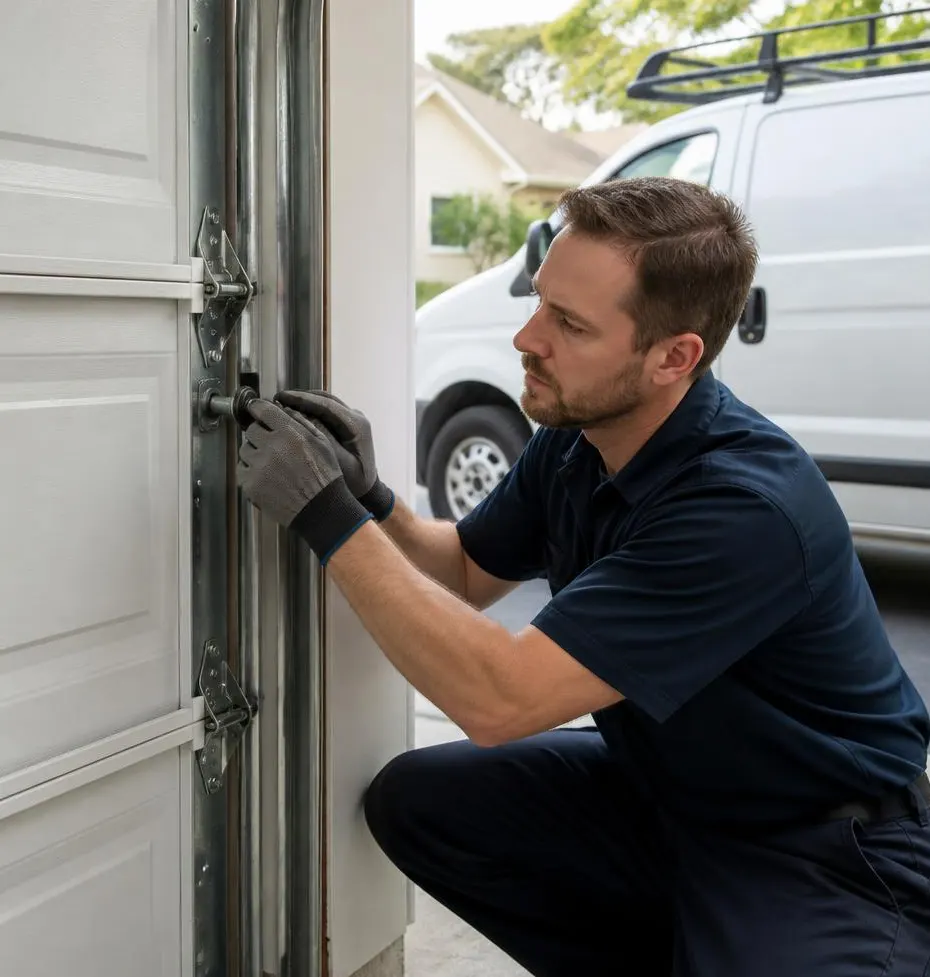
You're backing out for work before sunrise and you hear it — a sharp crack, almost like a gunshot, from somewhere above the garage door. The door won't budge, or it feels impossibly heavy when the opener strains against it. You grab a flashlight and find it: one of the torsion springs above the door has snapped clean in half, the metal coil twisted open like a broken watch spring.
Your first instinct might be to fix it yourself. Parts are cheap, videos make it look simple, and it's just a spring, right? This is one of the few repairs around the house where that instinct can put you in an emergency room.
What Actually Goes Wrong
A standard torsion spring is wound under massive tension to counterbalance a door that can weigh 130-400 pounds. That tension is the entire problem. When a spring is intact and wound correctly, it's doing the work of lifting that door hundreds of times a year without incident. When it's being installed, adjusted, or removed, all of that stored energy is concentrated in a few inches of coiled steel — and it releases instantly and violently if something slips.
The injuries that follow a common pattern:
- Crushed or broken fingers and hands when a winding bar slips out of the cone and the spring unwinds in a fraction of a second.
- Facial and eye injuries from metal fragments or the bar itself flying loose.
- Lacerations from snapped cables under tension, which whip rather than fall.
- Fractures and head injuries from falling off a ladder while holding a door panel that suddenly drops.
- Crush injuries when an improperly supported door comes down on a hand, foot, or torso mid-repair.
None of these require bad luck. They happen because the margin for error with stored spring tension is close to zero, and the tools involved — winding bars, vise grips, a ladder — offer no protection if the spring lets go while you're using them.
Why This One Repair Is Different
Most home repairs fail safely. A loose pipe fitting leaks. A bad outlet trips a breaker. A garage door spring under tension fails explosively, and the person closest to it is the one doing the repair. That's the distinction that makes this job worth handing off even for homeowners who are comfortable with tools.
There's also a local wrinkle. Homes built or retrofitted for wind-load codes along the Space Coast often use heavier, reinforced doors to handle hurricane-season gusts, which means stiffer, higher-tension springs doing more work year-round. Add in the humidity and salt air that speed up rust on cables, hinges, and spring coils, and you get hardware that's more likely to fail unpredictably — a spring that looks fine on the outside but is corroded on the inside and lets go without warning.
What to Do Instead When a Spring Breaks
- Don't force the door. If it's partway open, leave it. Don't yank the emergency release cord to lower it manually — without the spring's counterbalance, the full weight of the door will drop fast.
- Disconnect the opener so it doesn't keep trying to drive against a door it can't lift, which can burn out the motor or strip the gears.
- Keep the area clear. Don't let kids or pets near the door — broken cables and spring fragments can still be under partial tension even after the initial snap.
- Check which type of spring it is if you can see it (torsion springs run horizontally above the door on a metal shaft; extension springs run along the upper tracks) so you can describe it accurately when you call for service.
- Schedule the repair quickly rather than living with it — afternoon storms are a daily reality here most of the year, and a garage door stuck open or barely functioning during a downpour means water and wind getting into a space you don't want exposed.
When to Call Rockledge Garage Door
If you've got a snapped spring, a door that won't move, or cables that look frayed or loose, that's the point to stop and call in Spring Replacement or Emergency Garage Door Service rather than reaching for a winding bar. We bring the right tension tools, match the spring to your door's actual weight and cycle needs, and check the cables and pulleys at the same time, since a spring rarely fails in isolation after months of coastal humidity.
If your garage door has gone quiet in the worst way, call Rockledge Garage Door — we serve Rockledge and the surrounding Space Coast communities, and we'll get your door moving again safely.